
AI Assistant
Cart
Quote
FZK 011 Mechanical Thermostat, AC 120 V, +5 to +60 °C
SKU: 01170.9-01
Out of stock
Availability: Out of Stock
Marketplace sellers
Submit a quote request to receive offers from sellers of this product.
Short Description
Pricing available on request
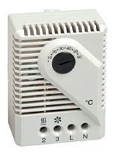
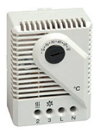
FZK 011 Mechanical Thermostat for Panels:
The mechanical thermostat is used to operate heating and cooling systems, filter fans, and signal devices.
The thermostat senses the ambient air and may switch between inductive and resistive loads using a snap-action contact.
The temperature setting on the scale equals the higher switch point, indicating that the NC contact is open.
The temperature setting minus the switch temperature differential (and tolerances) equals the lower switch point, indicating that the NC contact shuts.
Buy currently uses Select Automation shop pricing and checkout.
Specifications:
Voltage: 120 VAC.
Scale / Range: 50 to 140 ºF.
Contact Type: SPDT / Change-over.
Sensor Element: Thermostatic bimetal.
Switching Difference (Hysteresis): Approx. 9 ºF (5 K), reduced with RF.
Contact Resistance: < 10 mΩ.
Max. Switching Capacity:
Break contact: 10 A res./4 A ind. at 120 VAC.
Make contact: 5 A res./2 A ind. at 120 VAC.
DC: 30 W.
EMI/EMC Compliance: EN 55014-1-2, EN 61000-3-2, EN 61000-3-3.
Connection: 4-pole terminal for AWG 14 max. (2.5 mm²).
Mounting: Clip for 35 mm DIN rail (EN 60 715).
Dimensions (H x W x D): 2.64 x 1.97 x 1.5 inches (67 x 50 x 38 mm).
Housing: Plastic, UL 94V-0, light grey.
Weight: 2.74 oz (77.7 g).
Operating Temperature: -49 to 149 ºF (-45 to 65 ºC).
Storage Temperature: -49 to 149 ºF (-45 to 65 ºC).
Protection Type: IP20.
Features:
Mechanical Adjustable Thermostat: Used for controlling heating and cooling equipment, filter fans, or signal devices.
High Sensing Accuracy: Ensures precise temperature control.
Integrated Resistor (RF): Can be connected to improve the switch temperature difference.
Snap-Action Contact: Allows switching of both inductive and resistive loads.
UL Approved: Meets safety and performance standards.